Glowing neon blue globe outline with grid lines on a dark background, decorative icon for internet or global concept.

ISO 27001 compliance for Australian organisations

25+ years cyber · ISO 27001 certified · PCI DSS-compliant service provider · Australian owned and Australian staffed · Fixed and capped pricing available

The consequences of data breaches can be devastating, leading to financial losses and serious damage to an organisation’s reputation. This is where ISO 27001 compliance for Australian organisations shines. ISO 27001 offers an effective way to manage risks, helping to ensure that an organisation’s information and reputation are appropriately and effectively protected.

What is ISO/IEC 27001 and why is it relevant?

dotSec has more than 25 years of experience delivering practical security advice for government, APRA-regulated entities, financial institutions, utilities and national retail organisations. We focus on delivering ISO 27001 compliance for Australian organisations. And we ensure that the work will lead to the development and maintenance of an Information Security Management System (ISMS) that reduces the likelihood and impact of compromise, not some superficial, check-the-box circus.

ISO/IEC 27001:2022 is the internationally recognised standard for establishing, implementing, and maintaining an effective information security management system (ISMS). It offers an effective way to manage risks, helping to ensure that an organisation’s information and reputation are appropriately and effectively protected.

ISO 27001 defines the frameworks, processes, and organisational structures required to manage information security risks, and is adaptable to organisations of all sizes and industries. A defining feature of the standard is its emphasis toward monitoring and continual improvement in security management as opposed to an uncoordinated, set-and-forget approach relying on ‘must-have’ security products that often don’t work all that well in practice.

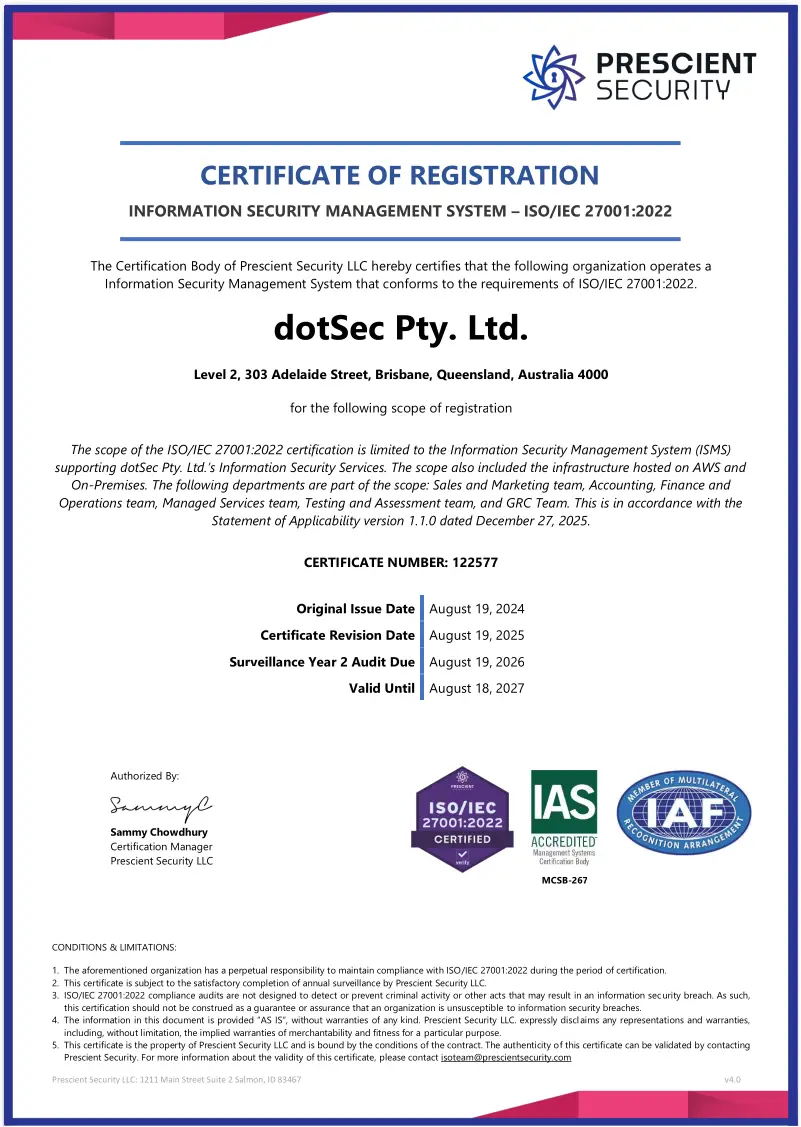
dotSec is compliant with ISO/IEC 27001:2022

dotSec achieved ISO/IEC 27001:2022 certification in 2024, and we’ve recently completed our first surveillance audit as well. 

ISO 27001 is a globally recognized standard that outlines the best practices for establishing, implementing, maintaining, and continually improving an Information Security Management System (ISMS) and this case study outlines the justification and motivation for taking on this compliance challenge.  

dotSec’s journey to ISO 27001 certification as not merely a compliance exercise; it reflects our deep commitment to safeguarding our clients’ data and maintaining the integrity, confidentiality, and availability of information assets. 

Our team has worked diligently to structure and implement an ISMS, a process that has involved the allocation of key roles and responsibilities, a comprehensive risk identification and treatment plan, the establishment of security objectives, and the implementation of robust controls to mitigate identified risks.

Having now achieved ISO 27001 certification ourselves, we have gained invaluable hands-on experience in managing our own ISO 27001 compliance project from start to finish. Although it’s included in any ISO 27001 documentation you might read, we now have a clear and personal understanding the way in which timely and affordable certification depends on effective leadership, project resourcing, detailed documentation, ongoing monitoring, and continuous improvement. 

Our insights and recommendations are rooted in real-world experience, ensuring that our clients benefit from the practical, tested strategies that we developed to drive our own successful certification outcome.

How does ISO 27001 benefit your business?

The consequences of data breaches can be devastating, leading to financial losses and serious damage to an organisation’s reputation. This is where ISO 27001 shines. It offers an effective way to manage risks, helping to ensure that an organisation’s information and reputation are appropriately and effectively protected.

ISO 27001 benefits your business by setting out the requirements for how to manage the security of various assets such as financial information, intellectual property, employee details, or information entrusted to a business by third parties.

Investing in ISO 27001 certification offers a multitude of benefits that extend beyond mere compliance. Here are some key advantages that underscore its value as a strategic investment:

Lower overall cost

A single data breach can generate costs that dwarf the investment required to implement ISO 27001. 

Beyond the immediate expenses related to incident investigation, containment, and remediation, organisations may face fines for breaching privacy obligations, legal fees, increased cyber-insurance premiums, and the financial impact of lost customers. 

ISO 27001 helps reduce these risks by identifying weaknesses, eliminating redundant processes, and creating a structured approach to managing information security. 

By addressing vulnerabilities before they become incidents, organisations avoid unplanned disruption and operational downtime. 

Over time, the disciplined, repeatable processes introduced through ISO 27001 contribute to more predictable costs, fewer surprises, and improved financial resilience across the business.

Increased revenue

ISO 27001 certification signals to customers, partners, and procurement teams that your organisation takes information security seriously and can back that claim with independently verified evidence. 

Many organisations now include ISO 27001 as a requirement in their supplier due-diligence process, meaning certification can open opportunities that would otherwise be inaccessible. 

Even where certification is not mandatory, the ability to demonstrate a mature security posture provides a competitive advantage and reduces friction during tender evaluations. 

It also supports customer retention: clients gain confidence knowing their data is handled according to a recognised international standard. By reinforcing trust and credibility, ISO 27001 can directly support revenue growth and strengthen long-term commercial relationships.

Lower overall risk

ISO 27001 provides a structured, repeatable framework for managing information security risks across the organisation. 

By establishing an Information Security Management System (ISMS), the business defines clear roles, responsibilities, and decision-making processes, ensuring that security is not dependent on individual knowledge or ad-hoc practices. 

The standard’s requirement for ongoing monitoring, internal audits, management reviews, and continual improvement means risks are revisited regularly rather than ignored until an incident forces action. 

This improves visibility at both operational and executive levels, enabling informed decisions about priorities, investments, and acceptable risk. 

The result is a more predictable governance environment, reduced uncertainty, and a stronger assurance that the organisation’s information assets are being protected effectively.

Stronger alignment

ISO 27001 helps organisations meet their regulatory, contractual, and industry-specific obligations by providing a clear, evidence-based structure for managing information security. 

Many compliance requirements (such as privacy legislation, financial regulations, and third-party due-diligence processes) expect organisations to demonstrate consistent control implementation and maintain relevant documentation. 

ISO 27001 naturally produces these artefacts, making audits, customer questionnaires, and regulatory reviews significantly easier to handle. 

Rather than reacting to compliance demands, organisations can proactively maintain a baseline that satisfies multiple frameworks at once. 

This reduces the administrative burden associated with proving compliance, lowers the risk of penalties, and delivers a more predictable and defensible compliance posture year-round.

How much does ISO 27001 certification cost in Australia?

ISO 27001 cost depends on three things: Two things you can budget for easily, but and one is a bit more tricky.

  1. The audit fee is paid to your certification body (BSI, SAI Global, NCS International or similar). It scales with staff numbers, sites in scope and the breadth of the ISMS. It is typically the smaller of the two costs.
  2. The consulting fee is paid to whoever helps you build the ISMS. This is the larger cost for most first-time certifications. It scales with how mature your organisation already is. An organisation with a working risk register, documented policies and a security-aware engineering culture needs far less help than one starting from a clean sheet.
  3. The thing you can’t easily budget for is remediation. If your gap analysis surfaces controls you don’t currently meet (and it will), the remediation cost depends entirely on which controls and how broken they are. A missing access-review process is cheap to fix. Re-architecting how you handle production data isn’t. dotSec’s first job is usually to help you understand that remediation forecast before you commit.

How dotSec prices ISO 27001 engagements

We quote one of two ways: fixed-fee for well-scoped work where we know exactly what’s involved, or capped time-and-materials when the scope is genuinely uncertain. In both cases you know your upper bound up front.

We do not run open-ended retainers for ISO 27001 implementation. Surveillance support after certification is usually a small monthly retainer or a fixed annual block.

If we can reduce your scope (and therefore the cost you pay your certification body), we will. Saving you money on the audit fee comes back to us in goodwill and long-term relationships, which is the kind of work we want.
The ISO 27001 implementation process

Implementation follows the same six-phase pattern across most engagements. The calendar time from scope to Stage 2 certification audit is generally between 3 and 9 months for most Australian organisations. The variables are starting-maturity and how many of the six phases your team can carry internally.

Scope and context

Step 1: Scoping and context

Define the boundary of the ISMS. Identify the products, services, sites and information assets in scope, and explicitly note what is out. Identify interested parties (customers, regulators, partners) and the obligations they impose. Scope is the single highest-leverage decision in the entire process.

Step 2: Risk assessment and treatment

Identify information assets, the threats against them, and the vulnerabilities those threats can exploit. Score the resulting risks. For each risk, decide whether to treat it (apply a control), transfer it (insurance, contractual), avoid it (stop doing the risky thing) or accept it (document and move on). The output is a Risk Treatment Plan.

Step 3: Statement of Applicability (SOA)

Document which of the 93 Annex A controls you are applying, which you are not, and why. The Statement of Applicability is the single most-scrutinised document in your Stage 1 audit. Get it tight, justify every exclusion, and you save weeks of back-and-forth.

Step 4: ISMS implementation

Roll out the policies, procedures, controls and evidence collection that the previous phases identified. This is the longest phase and the one where consulting help pays back the most: it is where strong-on-paper organisations slip on actually doing the work consistently.

Step 5: Internal audit and management review

Audit yourself against the standard before the certification auditor does. Capture findings, remediate, re-test. Then hold a management review where the leadership team formally reviews ISMS performance. Both are clauses 9.2 and 9.3 and both will be checked.

Step 6: Certification audit

Stage 1 of the certification audit is a documentation review. The certification body checks that your ISMS is documented to the level the standard requires. Stage 2 is an operational audit: the auditor tests whether the things you said you do, you actually do. Pass both and you receive a three-year certificate, contingent on annual surveillance audits.

ISO 27001 vs Essential Eight, CPS 234 and PCI DSS

ISO 27001 sits alongside several other frameworks Australian organisations often have to satisfy. They overlap but they are not interchangeable.

ISO 27001 vs Essential Eight

Essential Eight is a prescriptive technical baseline from the Australian Cyber Security Centre. It tells you which eight mitigations to implement and to what maturity level. ISO 27001 is a management-system standard. It tells you how to run security, not which specific controls to implement.

If you sell to Commonwealth agencies, Essential Eight is increasingly mandatory. If you sell to enterprise customers, ISO 27001 certification is increasingly mandatory. Many dotSec clients need both. We deliver them in one combined engagement because the Annex A control set and the Essential Eight mitigations overlap heavily, and running them together costs less than running them sequentially.

ISO 27001 vs CPS 234

CPS 234 is APRA’s prudential standard for information security. It is mandatory for APRA-regulated entities: banks, insurers, super funds.

ISO 27001 and CPS 234 share most of their DNA: risk-based information security, board-level accountability, third-party assurance, incident notification. ISO 27001 certification alone does not make you CPS 234 compliant (CPS 234 has Australian-specific obligations like the APRA notification requirement), but it gives you most of the evidence base. dotSec routinely delivers them together for APRA-regulated clients.

ISO 27001 vs PCI DSS

PCI DSS is the Payment Card Industry Data Security Standard. It is mandatory for any organisation that stores, processes or transmits cardholder data, and is enforced through acquiring banks and card schemes rather than government regulators.

ISO 27001 is broader: it covers all information assets, not just cardholder data, and is principles-based rather than prescriptive. PCI DSS tells you exactly which controls to implement and how to evidence them. ISO 27001 tells you to assess your risks and select controls proportionate to them.

Organisations that handle card data typically need both. The control overlap is substantial (access control, logging, vulnerability management, incident response, network segmentation), and dotSec routinely delivers them together. Running ISO 27001 and PCI DSS as a single engagement avoids duplicating evidence collection and control testing across the two frameworks.

Beyond other ISO 27001 certified companies in Australia

dotSec stands out among other ISO 27001 compliance companies in Australia for a couple of important reasons:

  • We’re ISO 27001-certified ourselves!  We don’t just talk the ISO talk, we’ve walked the compliance walk, so we know what it takes to implement and maintain a compliant ISMS.  
  • Our 27001 lead implementers and assessors have a wide range of certifications including PCI DSS QSA, ISO 27001, CISA, CISM and more.  We’re not just a one-shot, tick-the-box 27001 assessor company. 
  • Our ISO 27001 compliance and ISMS-implementation recommendations are practical, based on our actual, boots-on-the-ground implementation and compliance experience.  We’ve picked up after less experienced implementers who have confused the client with inappropriate controls and impractical compliance recommendations; no one needs those kinds of problems on top of an already-demanding compliance program of work. 

ISO 27001 compliance FAQ

What is ISO 27001 compliance?

ISO/IEC 27001:2022 is the international standard for an Information Security Management System (ISMS). 

Compliance means your organisation has established, documented and is operating an ISMS that meets the standard’s clauses 4 through 10 and has selected, justified and implemented controls from Annex A. 

Compliance is an ongoing state. Certification is the independent confirmation of it.

Australia adopts ISO/IEC 27001:2022 unchanged. There is no Australian variant. 

Certification is issued by JAS-ANZ-accredited certification bodies, for example BSI, SAI Global and NCS International, and is recognised globally. 

For APRA-regulated entities, ISO 27001 alignment supports CPS 234 readiness but does not replace it.

It is a structured way to identify your information security risks, decide which to fix, and prove to yourself, your customers and a third-party auditor that the controls you said you would implement are actually working over time.


Total cost has two parts: consulting and the certification audit.

The audit fee is charged by the certification body (BSI, SAI Global, NCS International or similar) and depends on staff numbers, sites in scope, and the breadth of the ISMS.

The consulting cost depends on starting maturity. An organisation with mature controls, working policies and an active risk register needs far less external help than one starting from a clean sheet.

DotSec quotes either fixed-fee or capped time-and-materials so you know your upper bound up front. Typical DotSec engagements range from A$15K upwards. First-time certifications generally land in the upper of the range because more process creation and evidence gathering is required. We will give you a fixed quote after a no-cost scoping conversation.

Six phases, mapped to the Plan-Do-Check-Act cycle:

  • Scope and context. Define the boundary of the ISMS and identify interested parties.
  • Risk assessment and treatment. Identify information assets, threats and vulnerabilities; decide treatment for each risk.
  • Statement of Applicability. Document which Annex A controls apply and why.
  • ISMS implementation. Roll out the policies, procedures, controls and evidence collection.
  • Internal audit and management review. Test the system against the standard before the auditor does.
  • Certification audit. Stage 1 documentation review, then Stage 2 operational audit. Followed by annual surveillance audits.

For most Australian organisations, the calendar time from scope to Stage 2 is four to eight months, depending greatly upon the organisation’s resourcing and availability of a qualified, resourced point of contact.

Defining scope completely and correctly. 

Get scope wrong and every other phase compounds the error. 

Scope sets which products, services, sites, teams and information assets the ISMS covers, and just as importantly, which it does not. 

Advisory articles indicate that failed certification attempts trace back to an over-broad initial scope.

They solve different problems.

Essential Eight is a prescriptive technical baseline produced by the Australian Cyber Security Centre. It is mandatory for certain Commonwealth entities and increasingly used as a procurement requirement.

ISO 27001 is a management-system standard. It tells you how to run security as an ongoing discipline, not which specific controls to implement.

Most DotSec clients need both: ISO 27001 to satisfy customers, partners and auditors that information security is governed properly, and Essential Eight to satisfy government-aligned procurement and provide a hard technical floor. The two are complementary and we routinely deliver them in one engagement.

CPS 234 is APRA’s prudential standard for information security. It is mandatory for APRA-regulated entities: banks, insurers and super funds.

ISO 27001 alignment supports CPS 234 readiness because the two share much of the same control DNA: risk-based information security, board-level accountability, third-party assurance and incident notification. ISO 27001 certification on its own does not make you CPS 234 compliant, but it gives you most of the evidence base. DotSec routinely delivers them together.

No. The 2022 revision is the current version. It reorganised Annex A into 93 controls grouped under four themes (Organisational, People, Physical, Technological) and added explicit controls for threat intelligence, cloud security, secure development, data masking and ICT readiness for business continuity.

The 2013 version is no longer eligible for certification. The transition deadline passed on 31 October 2025.

Compliance is the state. Certification is the independent confirmation of compliance, issued by a JAS-ANZ-accredited certification body, that an external auditor has tested your ISMS against the standard and found it conforming to the requirements of the standard.

Many customers, government agencies and procurement teams now require certification, not self-attested compliance, as a precondition to doing business.

Yes, and some organisations do, particularly those with an existing in-house GRC team and prior compliance experience.

The two situations where external help pays back are first-time certification (where the cost of false starts is high) and organisations whose internal team is too close to operations to be effective at the internal-audit step.

DotSec is happy to scope you and tell you honestly whether you need us, partial help, or just an internal-audit pair of eyes.

What next?

If you want ISO 27001 implementation or assessment help, dotSec is here for you! Our team of experienced professionals can guide you through the entire process, helping you to reduce scope and reporting costs wherever possible. Doesn’t saving you cost reduce our income? Why yes, for one job it does! But if we can cut the costs you’ve been paying to your incumbent 27001 auditor or implementer company, you’ll be happier and that’s the recipe for the kind of long-term relationship that we value above all else.

Ensuring compliance with ISO 27001 has the potential to be risky, painful and expensive experience, but with a dotSec ISO 27001 ISMS specialist by your side, your journey becomes a lot easier..

Premier Australian cyber security specialists