
Misconfigurations, incomplete patching and inconsistent control coverage remain among the most common causes of compromise in Australian organisations. The ACSC Essential Eight provides a prioritised set of mitigation strategies that address the threats most likely to succeed against real environments, along with a maturity model that gives organisations a measurable and defensible way to describe and improve their security posture.
dotSec performs independent Essential Eight maturity assessments across all four maturity levels. Our assessments identify how well your organisation meets the ASD maturity requirements, which risks remain, and which improvements will deliver the most meaningful uplift.
Some providers rely entirely on automated scanning and market that output as an ACSC Essential Eight assessment report. Automated tools are useful but they cannot evaluate policy coverage, configuration consistency, privileged access designs, operating procedures, or the subtle differences between intended controls and how they function in real environments.
There is an inherent risk in environments that pass a scan but later fail to correctly implement the guidelines, particularly when evidence, procedures and configurations are reviewed in a formal context. A proper Essential Eight maturity assessment requires document analysis, interviews, observation, sampling and validation of control operation. That is the standard dotSec applies.

dotSec begins with a structured, independent assessment of your current alignment with the ACSC Essential Eight maturity model. This includes evidence reviews, interviews, configuration sampling and technical analysis across selected systems, cloud services and user devices.
The assessment determines your maturity level for each of the eight mitigation strategies, from Level Zero through to Level Three. It identifies where controls operate well, where they fall short of ASD expectations, and where control design differs from actual operation.
Your baseline report provides a clear, factual and defensible view of current maturity that can be shared with IT teams, leadership and external stakeholders.

Once the baseline is established, dotSec verifies how effectively the in-scope controls operate day to day.
This includes reviewing configuration consistency, analysing operational processes, checking evidence of repeatability, and validating that implemented controls genuinely meet the intent of ASD’s maturity level requirements.
This step highlights the difference between controls that exist on paper and controls that operate as designed.
It also identifies systemic issues such as configuration drift, dependency on manual workarounds, or gaps that automated scanning tools cannot detect.

dotSec delivers a prioritised and actionable improvement roadmap aligned with the ASD maturity model, your operational constraints and your risk profile. Recommendations are structured to support rapid uplift where it has the greatest effect, and strategic changes where deeper improvements are required.
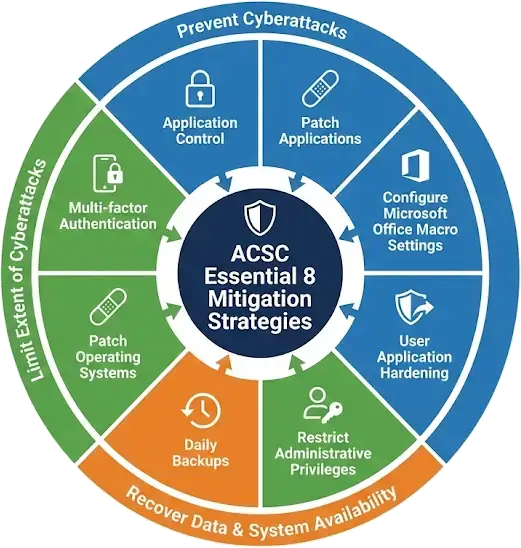
The roadmap outlines the steps needed to progress from your current maturity to your target maturity level, covering patching cycles, configuration hardening, privileged access controls, application control policies, backup integrity processes and procedure updates.
dotSec can continue to assist by validating uplift progress and supporting ongoing improvement toward sustained ACSC Essential Eight maturity
dotSec delivers Essential Eight assessment and uplift services that are practical, evidence-driven and grounded in real operational experience:
The first step is to evaluate your environment against the ASD Essential Eight maturity model. This initial evaluation shows how closely your controls map to the expected behaviours and outcomes at each maturity level, from Zero to Three. Once that baseline is established, you are better positioned to prioritise your uplift journey.
Reference: ASD Essential Eight Maturity Model
It’s both, and they work together. The term “Essential Eight” refers to the eight highest-priority mitigation strategies from the ASD’s broader list of 37 Strategies to Mitigate Cyber Security Incidents. The Essential Eight Maturity Model then provides a structured way to implement those strategies and measure how effectively they are operating, across four maturity levels from Zero to Three.
Reference: ASD Essential Eight Maturity Model
A structured Essential Eight engagement delivers three clear outcomes.
First, it identifies and prioritises practical improvement opportunities: our assessors highlight where controls fall short of the intended maturity outcomes, with recommendations tailored to uplift your posture in a way that makes operational and business sense.
Second, it supports meaningful risk reduction. The Essential Eight is designed to address credible and common threats. dotSec identifies the improvements that will reduce risk most quickly and effectively while preparing you for higher maturity levels.
Third, it establishes a clear, authoritative baseline for stakeholders. Your report provides an evidence-based view of Essential Eight maturity across the organisation, supporting planning, budgeting and decision-making at all levels.
If you need an independent Essential Eight maturity assessment, a gap analysis against your target maturity level, or practical support implementing controls, dotSec can help.
We tailor each engagement to your environment, your risk profile and your operational constraints. If there is an opportunity to focus effort where it will deliver the most meaningful uplift, we will identify it. That makes the work more efficient, the results more defensible, and the improvement more sustainable.
Contact us to discuss your Essential Eight requirements.
Practical and experienced Australian ISO 27001 and ISMS consulting services. We will help you to establish, implement and maintain an effective information security management system (ISMS).
DotSec’s penetration tests are conducted by experienced, Australian testers who understand real-world attacks and secure-system development. Clear, actionable recommendations, every time.
dotSec stands out among other PCI DSS companies in Australia: We are not only a PCI QSA company, we are a PCI DSS-compliant service provider so we have first-hand compliance experience.
Web Application Firewalls (WAFs) are critical for protecting web applications and services, by inspecting and filtering out malicious requests before they reach your web servers. Web page or API, a WAF is your first defence.
Multi-Factor Authentication (MFA) and Single Sign-On (SSO) reduce password risks, simplify access, letting verified and authorised users reach sensitive systems, services and apps.
dotSec provides comprehensive vulnerability management services. As part of this service, we analyse findings in the context of your specific environment, priorities and threat landscape.
We don’t just test whether users will click a suspicious link — we also run exercises, simulating phishing attacks that are capable of bypassing multi-factor authentication (MFA) protections.
DotSec’s penetration testing services help you identify and reduce technical security risks across your applications, cloud services and internal networks. Clear, actionable recommendations, every time!
dotSec has provided Australian managed SOC, SIEM and EDR services for 15 years. PCI DSS-compliant and ISO 27001-certified. Advanced log analytics, threat detection and expert investigation services.
We provide prioritised, practical guidance on how to implement secure configurations properly. Choose from automated deployment via Intune for Windows, Ansible for Linux or Cloud Formation for AWS.
Secure web hosting is fundamental to protecting online assets and customer data. We have over a decade of AWS experience providing highly secure, scalable, and reliable cloud infrastructure.
DotSec helps organisations to benefit from the ACSC Essential Eight by assessing maturity levels, applying practical security controls, assessing compliance, and improving resilience against attacks.
Evaluation against the CIS 18 Controls establishes a clear baseline for stakeholders, supporting evidence-based planning, budgeting, maturity-improvement and compliance decisions
We have over 25 years of cyber security experience, providing practical risk-based guidance, advisory and CISO services to a wide range of public and private organisations across Australia.